

Below you'll find all the guides we have assembled to help you get started with Electronics.
Getting Started
- An Introduction to basic electronics
In electronics we control the flow of electricity around a circuit to perform tasks.
Electricity is the movement of electrons around a circuit, this movement is driven by a potential difference (Measured in Volts V) through a circuit with some resistance to that flow (measured in ohms Ω). The amount of electricity flowing through that circuit is known as the current and is measured in Amps.
- Volts push Amps through Ohms!
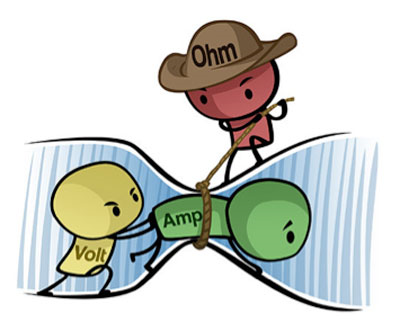
The relationship between these 3 is called Ohm's law, and it can help us to find out what is happening in a circuit.
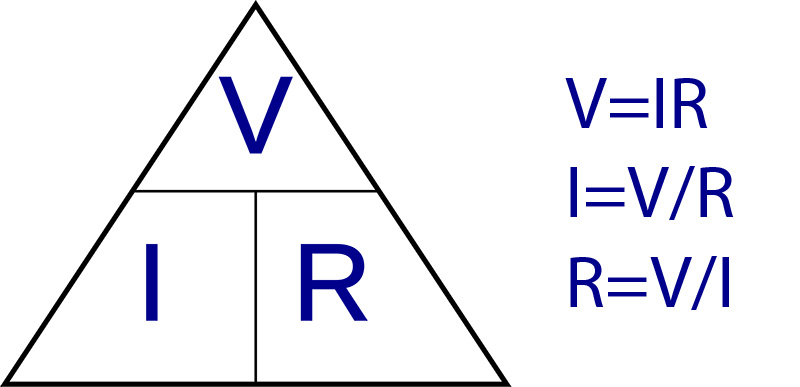
Most circuits you will come across will have a fixed supply voltage, so you can calculate the current flow caused by a known resistance, or calculate the resistance required to proveide a desired current.
Voltage is delivered in 2 main ways,  via Direct current (DC) or Alternating Current (AC).

In DC there is a constant voltage, for example in 5V DC like we see in USB power there is always a 5V potential difference between our positive and ground.
In AC power like we see in mains electricity we have a constantly changing voltage, the Voltage oscillates between positive and negative, as does the current in the circuit. AC power is more common in high powered devices or situations where we are handling audio or other continuously variable signals.
Soldering
- An Introduction to 3D
Breadboarding and electronic Components
- An Introduction to 3D
Other Electronics Equipment
- An Introduction to 3D
Arduino
- An Introduction to 3D
Raspberry Pi
- An Introduction to 3D